
Cloud generator · AI Image Generator
Text to Image Generator
Text to image means a machine reads your sentence and paints an answer to it. This page accepts up to nine hundred characters, offers six style starting points and five shapes, and returns a PNG file. The wording does most of the work: one subject, one setting, and one lighting cue beat a longer paragraph of adjectives, and you can run it again as often as the hourly allowance permits.
Free to use. This generator works on our server: your description is sent, a picture comes back, and nothing is kept. Every connection gets 8 free pictures an hour, and the count resets at the top of the next hour.
Write the sentence, take the picture
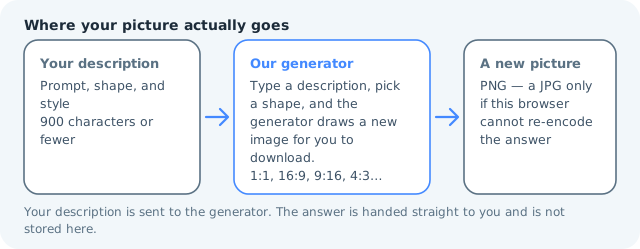
A description box, six style starting points, and five shapes: the model reads your words and returns a matching PNG you can download. Up to 900 characters, PNG output.
of 900 characters
Square, wide, tall, classic, and portrait are cut from the middle of the picture the generator returns, so keep the subject centred and check the preview before downloading.
Your last picks here were different.
One quick human check, then you are back to generating.
Press once and wait; a finished picture usually takes ten to thirty seconds.
Your picture
AI Image Generator at a glance
| What you give it | A written description, 8-900 characters |
|---|---|
| Files you get back | PNG — a JPG only if this browser cannot re-encode the answer |
| Shapes | 1:1, 16:9, 9:16, 4:3, 3:4 |
| Where the work happens | On our generator — your description is sent, the picture is not stored |
| Account, price | No sign-up, no charge |
| Free pictures per hour | 8 per connection, and the count resets at the top of each hour |
When this helps
- A line of copy that needs a matching picture by tomorrow
- A scene too specific to find in a stock library, such as a labelled prop or an odd angle
- A placeholder for a layout you are testing before the real shoot exists
- Wording practised against several aspect ratios to see which one carries the idea
A working sentence: “a red bicycle leaning against a wet kerb at dusk, warm streetlight, shallow depth of field”. Subject, place, light, and lens, in that order, which is roughly how strongly each one is weighted in the result.
Detailed guidance
The four things a machine looks for in a sentence
Whatever you write, the model has to settle four questions on its own unless you settle them for it: what is in frame, where it is, how it is lit, and how the picture was made. Miss one and it invents one, usually in the most average way available. That is why the classic weak request, a beautiful sunset, produces a postcard: the medium was never specified, so the statistically ordinary interpretation wins. Add “shot from a low angle, wet sand in the foreground, overcast after rain” and you have answered three of the four, and the result stops looking stock.
Word order, and why the beginning matters
Phrases are not equal. Early clauses carry more weight than late ones, and a long sentence lets the model average its way toward something bland. Put the subject first, then the setting, then light and viewpoint, then the medium last so it colours everything. If a detail keeps being ignored, move it forward. If an unwanted object keeps appearing, do not write about its absence — a negation still mentions the thing, and mentioning is what the model understands. Say what is there instead.
Choosing a shape before you write
Aspect is not cosmetic. A square crops a scene to a middle, which suits a single object or a face. Sixteen by nine gives room for a horizon and reads as a still from a film. Three by four and four by five flatter a standing figure or a page layout. Nine by sixteen is the phone shape, and it will fill the frame with a foreground because there is nowhere else to put the subject. Decide the destination first: an image for a story header and an image for an avatar are different commissions, and asking for the wrong one wastes a run.
Style presets, and when to skip them
The six presets exist because naming a medium is the highest-leverage single edit available. “Photograph” implies depth of field, grain, and honest colour; “line art” implies flat white ground and no shading at all; “pixel art” implies chunky blocks and a tiny palette. Choosing one is faster than writing three clauses about it, and it keeps your own sentence free to describe the scene. Skip the preset when you already know what you want the surface to look like, because then a specific phrase you write will beat a generic label every time.
When the picture comes back wrong
Diagnose by clause. Something in the frame that you did not ask for came from a word you did use, since models rarely invent from nothing. A missing element was the vaguest phrase in the sentence, so make it concrete and put it earlier. Wrong atmosphere is nearly always a lighting failure, so name a time of day and a weather condition rather than a mood. Hands, teeth, glasses, and text are model weaknesses that no wording fixes reliably, so recompose to hide them — a subject with one hand in a pocket, a sign seen from an angle where it is not legible. If two runs of a sentence both fail in the same place, the sentence is the problem, not the machine.
Finishing the job
A generated picture is a raw asset. Resize it to the exact pixel box the destination wants, compress it so a header image does not slow the page down, and set any real text over it with the editor rather than asking the model to spell. All of those steps happen locally in your browser on the other pages of this site, which is the right division of labour: the cloud does the inventing, and your machine does the measuring.
Text to Image Generator questions
How do I turn a sentence into a good picture?
Name a subject, a place, and a quality of light, in that order, and stop. “A crowded market stall, early morning, low sun through canvas” works because every phrase answers a question the model has to decide anyway. Adjectives about mood are the first thing it discards.
How long should a text to image sentence be?
Shorter than you think, up to the nine hundred characters this box allows. A single clause per decision — subject, setting, light, viewpoint, medium — covers almost everything that survives into the output. Long paragraphs dilute each other, and the last phrase often wins.
What is the difference between my sentence and a style preset?
Your sentence describes the scene. A preset describes the medium: photograph, vector illustration, watercolour, pixel art, or line art. The preset is appended for you, which keeps the two jobs separate and means you can change the look without rewriting what is in the picture.
Can it make logos or readable signs?
Not reliably. Letterforms are the weakest part of every model in this family, so a generated shop sign arrives as plausible gibberish and a generated logo arrives as a generic symbol. Draw the artwork here, then set real type over it in the image editor afterwards.
Why do two runs of the same sentence look different?
Because rendering starts from random noise, and the starting noise is chosen afresh each press. Two passes are therefore two attempts at the same brief rather than the same attempt twice, which is why running a good sentence a few times is a real strategy rather than a waste of allowance.